Throughout its existence, the Detroit Water & Sewerage Department (DWSD) has disposed of most of its sewage sludge (aka biosolids) by incineration or in landfills. (Small amounts have gone to farms as fertilizer.)
The high cost of maintaining and rebuilding the incinerators, more strict air quality standards and limitations imposed by landfills caused DWSD in 2013 to contract with the New England Fertilizer Company (NEFCO) to design, build and operate a plant in Detroit to dry and pelletize a significant portion of the sludge for use as fertilizer and power plant fuel.
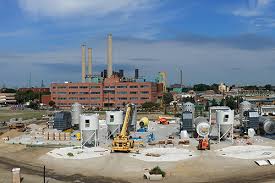 |
| NEFCO photo: construction in Detroit |
Under DWSD’s contract with NEFCO, sewer system ratepayers will be on the hook for nearly $700,000,000 over 20 years.
Last month, DWSD executive director Sue McCormick reported that substantial completion of NEFCO’s Detroit facility is expected this month (December 2015).
The NEFCO plant will replace the six oldest of 14 incinerators. The facility is expected to process incoming sludge at a modest rate of 300 (relatively dry) tons per day (dtpd), 400 in a pinch. DWSD’s average sludge production the past year has been about 400 dtpd. (If memory serves, sludge production was required to be at least 450 dtpd under the Second Amended Consent Judgement when DWSD was overseen by a federal judge.)
The daily tonnage that isn’t removed from wastewater ends up in the Detroit River and then Lake Erie. So, if there are 550 tons of biosolids in the wastewater on the average day and DWSD removes 400 (perhaps 300 of which will go to NEFCO for pelletizing; 100 incinerated), that means that the remaining 150 tons daily or 54,750 tons annually will feed the algae in Lake Erie. (If there’s more to this calculation than meets the eye, DWSD hasn’t been forthcoming about it.)
There are plans to phase out the remaining eight incinerators in ten years. That’s enough time to install around the region several Janicki wastewater processors, which produce pure water, significant amounts of electricity and a small pile of ash (NO sludge). The Detroit wastewater treatment plant and the NEFCO facility would no longer be necessary.
***** **jl** *****

