Showing posts with label Macomb Daily. Show all posts

Monday, October 17, 2016

Oakland Justifies Lake St. Clair Pollution

For years, local authorities have treated combined sewer overflows (CSOs) with chlorine to kill bacteria in preparation for diverting the overflow following heavy rains away from wastewater treatment plants and into natural water bodies.

The U.S. Environmental Protection Agency has been urging state and local officials to convert combined sewer systems into separate sanitary and stormwater sewer systems.


“Oakland County dumped 2 billion gallons of sewage into Macomb in August storm”“Several hours after the Aug. 11 [2014] storm, the polluted Red Run Drain in Warren was still about 20 feet above its normal level.”
http://www.macombdaily.com/article/MD/20140826/NEWS/140829703

Thereafter, pathogens, toxins and nutrients originating in household wastewater would go to a wastewater treatment plant for removal while the heavy volume of rainwater would flow separately, directly into lakes and streams. Cities like Lansing and Grand Rapids have undertaken such conversions.
 
Oakland County Water Resources Commissioner Jim Nash justifies not planning for separate stormwater and sanitary sewage systems by arguing that separated stormwater runoff is not treated, so whatever pollutants it carries off streets, parking lots and roofs ends up in lakes and streams.

Presently, Nash sends combined storm and sanitary effluent from the giant Kuhn Retention Basin in Madison Heights to a wastewater treatment plant in Detroit.

If heavy rainfall threatens to overwhelm the treatment plant, Nash partially treats the combined fluids with chlorine to control pathogens such as bacteria and sends the deluge into Red Run, through Macomb County to the Clinton River and Lake St. Clair.

But the sanitary sewage component contains the nutrients like phosphorus that are found in human waste. Those nutrients generate algal blooms, some with toxic potential, that contribute to the degradation of Lake St. Clair.

In other words, Nash seems content to pass on to Lake St. Clair the pollutants in the waste of hundreds of thousands of people rather than the separated stormwater running off roofs and pavements.

Go figure.

Monday, January 4, 2016

GLWA Takes the Reins


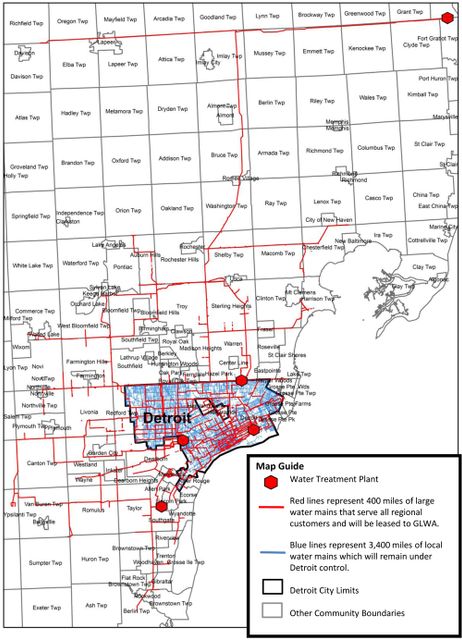
As of the first of the year, the Great Lakes Water Authority (GLWA) now manages water and sewer service for most of metropolitan Detroit. It succeeds the Detroit Water & Sewerage Department (DWSD), which becomes a wholesale service purchaser from GLWA and retail distributor exclusively to the city itself, designated DWSD-R (R for Retail).

Sunday, October 4, 2015

MACOMB DAILY Examines Future Water Costs

An article in the Macomb Daily by Norb Franz on September 28, 2015 about the cost of overdue water infrastructure upgrades is noteworthy.  Data in the accompanying graphic are especially revealing   Under the title “Billions needed to keep water systems working,” Franz wrote (excerpts):

Around the country, scores of decaying drinking water systems built around the time of World War II and earlier are in need of replacement. The costs to rebuild them will be staggering.

But without big changes in national policy, local governments and their ratepayers will be largely on their own in paying for the upgrades. The amount of federal money available is a drop in the bucket.

The U.S. Environmental Protection Agency projects it will cost $384 billion over 20 years just to maintain the nation’s existing drinking water infrastructure. Replacing pipes, treatment plants and other infrastructure as well as expanding drinking water systems to handle population growth could cost as much as $1 trillion.

New Orleans once boasted about not raising water rates for two decades. But in 2012, the city approved 10 percent increases on water bills for eight straight years as part of a plan to fix its crumbling system. The average household’s monthly water-and-sewer bill will climb to $115 by 2020.

Michigan ranks 27th in per capita federal spending for capital improvement projects for water. The state ranks 9th in projected money needed over 20 years at $13.8 billion…

Locally, the city of Mount Clemens, which operates its own water filtration plant and a waste water treatment plant, has borrowed $16.6 million to finance water system improvements. The last time was 2007, when $3.9 million was used for various upgrades, including an ozone system.

On the waste water side, Mount Clemens has borrowed $22 million. Nearly one-third is still to be paid off. That includes $1.19 million in 2010 from the State Revolving Fund for an ultraviolent light treatment system that cuts down on the use of chemicals. The city of Warren made the same improvement years ago.

There’s much, much more of interest in Franz’s piece, as well as the graphic.