Showing posts with label combined sewer overflows (CSOs). Show all posts

Monday, October 17, 2016

Oakland Justifies Lake St. Clair Pollution

For years, local authorities have treated combined sewer overflows (CSOs) with chlorine to kill bacteria in preparation for diverting the overflow following heavy rains away from wastewater treatment plants and into natural water bodies.

The U.S. Environmental Protection Agency has been urging state and local officials to convert combined sewer systems into separate sanitary and stormwater sewer systems.


“Oakland County dumped 2 billion gallons of sewage into Macomb in August storm”“Several hours after the Aug. 11 [2014] storm, the polluted Red Run Drain in Warren was still about 20 feet above its normal level.”
http://www.macombdaily.com/article/MD/20140826/NEWS/140829703

Thereafter, pathogens, toxins and nutrients originating in household wastewater would go to a wastewater treatment plant for removal while the heavy volume of rainwater would flow separately, directly into lakes and streams. Cities like Lansing and Grand Rapids have undertaken such conversions.
 
Oakland County Water Resources Commissioner Jim Nash justifies not planning for separate stormwater and sanitary sewage systems by arguing that separated stormwater runoff is not treated, so whatever pollutants it carries off streets, parking lots and roofs ends up in lakes and streams.

Presently, Nash sends combined storm and sanitary effluent from the giant Kuhn Retention Basin in Madison Heights to a wastewater treatment plant in Detroit.

If heavy rainfall threatens to overwhelm the treatment plant, Nash partially treats the combined fluids with chlorine to control pathogens such as bacteria and sends the deluge into Red Run, through Macomb County to the Clinton River and Lake St. Clair.

But the sanitary sewage component contains the nutrients like phosphorus that are found in human waste. Those nutrients generate algal blooms, some with toxic potential, that contribute to the degradation of Lake St. Clair.

In other words, Nash seems content to pass on to Lake St. Clair the pollutants in the waste of hundreds of thousands of people rather than the separated stormwater running off roofs and pavements.

Go figure.

Tuesday, August 9, 2016

Stormwater Runoff Fees Omitted on 20,000 Detroit Properties

Over 20,000 parcels that contribute stormwater runoff but aren’t being charged will be added to DWSD’s billing system this October.

***  SUMMARY  ***

Every year, billions of gallons of contaminated stormwater runoff and snowmelt pour off roofs, sidewalks, parking lots and other impervious surfaces into Detroit’s combined sewer system, then perhaps to a retention-treatment basin (RTB) and eventually to the wastewater treatment plant. The Detroit Water and Sewerage Department (DWSD), Detroit’s retail water agency for the Great Lakes Water Authority (GLWA), says this runoff costs more than $125 million annually.
Federal and state regulators required DWSD to spend more than $1 billion in combined sewer overflow storage facilities (RTBs) to reduce polluted overflows into natural waterways like the Detroit River. The drainage charge to property owners offsets this investment and the drainage treatment costs.
Most DWSD customers have been paying for drainage as part of their water and sewer bills. The City Assessor’s Office and DWSD are working to ensure that all parcels are billed for their share of drainage costs.
DWSD intends to begin a green infrastructure credit program in October. Customers who reduce runoff can earn credits to be applied to their bill. Fair, accurate billing and green infrastructure practices will benefit the city and its residents.
DWSD provides a  Parcel Viewer  on which to search for parcel information by address. Impervious surface area is used to calculate drainage charges. DWSD says it has data from the City Assessor's Office and flyover images to determine impervious surfaces. Property owners who disagree with the data can complete a drainage survey form.
Over 20,000 parcels that contribute stormwater runoff but aren’t being charged will be added to DWSD’s billing system this October. Customers who need to update parcel information or ask questions should contact DWSD.  A Customer Steering Committee meeting has been scheduled for July 14, 2016.
http://www.detroitmi.gov/drainage

Thursday, June 30, 2016

Worms to Help with Detroit’s Remaining CSOs

Who knew? Now Detroit can handle 95% of its combined sewer overflows! Worms will help with the remaining 5%.

On June 24, 2016, The Atlantic City Lab published an article by Jessica Leigh Hester titled “Detroit Is Turning Vacant Lots Into Sponges for Stormwater.” Hester reports (excerpts):

Detroit’s aged sewer system carries both sanitary sewage and stormwater. It overflows into creeks and rivers after heavy rains.

“Over the last two decades, the city has poured $1 billion into upgrading the system; now, its six retention basins and three treatment facilities can accommodate approximately 95 percent of the untreated overflow—an improvement, but an imperfect solution. ‘How do you get to the last 5 percent of the problem?’ asks Palencia Mobley, the deputy director of Detroit Water and Sewerage. ‘Spending another $1 billion or $2 billion doesn’t make a lot of economical sense.’ To bridge the gap, the city has pivoted to focus on green infrastructure …”

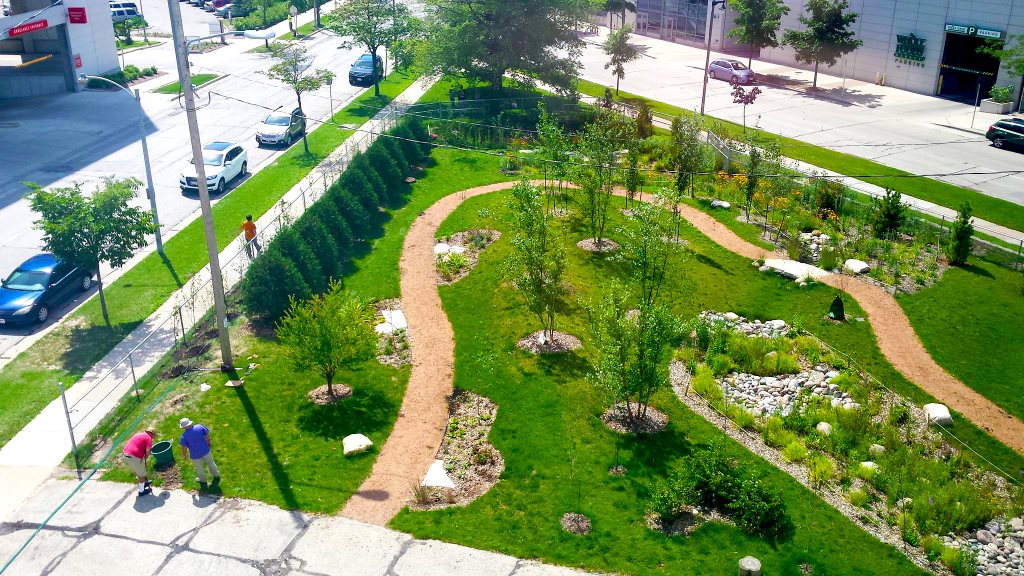
Image Courtesy of Joan Nassauer
Rendering, bio-retention garden, Warrendale neighborhood. (Courtesy of Joan Nassauer)

Small scale stormwater interventions may suffice in other, more crowded cities, but Detroit has plenty of room for larger projects.

“It’s a sprawling city, with vacant or buckling properties scattered across its 139 square miles. As of April 2016, 66,125 vacant parcels were held by the Detroit Land Bank Authority, which has received more than $100 million in federal funds to demolish blighted structures.”

“This spring and summer, researchers across the city are investigating the immediate and long-term ecological and sociological benefits of turning vacant land into stormwater basins topped with colorful plants.”

“Wade Rose, the vacant land restoration manager at the reforestation and farming organization the Greening of Detroit, described the process of remediating parcels that have been untended for decades. The houses that used to sit on top of them, Rose says, were demolished before the current protocols were put in place; they might have been bulldozed into the basement and sealed off.”

“The project deploys various techniques for soil remediation and water retention: a wildflower meadow; a tree stand, in which oak trees’ roots fracture compacted soils; rain gardens with deep depressions; and a treatment that deposits 100,000 worms at depths ranging from 2-6 feet, creating a network of tunnels that make space for storm water.”

http://www.citylab.com/cityfixer/2016/06/detroit-vacant-lots-gardens-stormwater/488342/

Saturday, February 20, 2016

Tear-up Abandoned Parking Lots


Less Costly Shortcut to Urban Stormwater Control 

Commercial property owners like to lay down as much concrete as they can, beyond what might be deemed necessary for parking and sidewalks, because in the long run it saves them the cost of labor, equipment and materials to cut grass and control weeds.  Some like asphalt even more because it’s cheaper than concrete, at least in the short run.

The drawback is that stormwater runs right off of concrete and asphalt (and roofs), straight into city sewers. In cities that have two sewer systems, one for household, commercial and industrial wastewater and a separate system for stormwater runoff, the consequences of storm runoff are less severe. It’s easier, thus less costly, to treat and moderate rainwater runoff.

Many older, larger cities like Detroit, however, have combined sewer systems where wastewater and stormwater flow together, often overwhelming wastewater treatment plants.

To meet the demands of clean water laws, some cities with combined sewers (like Chicago or Atlanta, for example) have been required to build huge tunnels to temporarily hold combined sewer discharges during and after storms, thereby preventing combined sewer overflows (CSOs) from inundating treatment plants or being released untreated into natural water bodies.

Several years ago, there were plans to build such a tunnel in Detroit, but the city’s insolvency prevented implementation. Instead, a number of smaller facilities called retention treatment basins (RTBs) were chosen to control overflows. Whether or not RTBs, some still under construction, will be sufficient to manage overflows and prevent the pollution of lakes and streams remains to be seen.

www.laurensgardenservice.com


In the meantime, various types of green infrastructure or low impact development (LID) offer some relief from the polluted runoff problem. These would include rain barrels, ground-level and roof-top rain gardens, permeable pavers, detached downspouts and bioswales. Note the success of one such LID project, a retrofit in the Towar neighborhood near East Lansing, Michigan;  http://detroitwatersewerblog.blogspot.com/2014/11/stormwater-success-story.html

But I digress. The point is that an overabundance of concrete and asphalt, mostly in underused or abandoned parking lots, contribute significantly to urban stormwater runoff and combined sewer overflows.

In metropolitan areas like Detroit, where populations have declined, sprawling parking lots at commercial, industrial, municipal, sports venue and similar sites could be reduced in size, sometimes drastically.

Consider the acres of unused pavement at abandoned sites like Northland Mall or the Pontiac Silverdome. Funds to remove hard surfaces would be available if we got our priorities straight.

Simply returning such areas or large parts thereof to their natural surface, augmented with vegetation of some kind, would be a lot cheaper than installing more concrete and steel RTBs or sophisticated green infrastructure improvements farther downstream.

Satellite view of Northland Mall’s empty parking lots:
https://www.google.com/maps/@42.4509185,-83.2060912,1375m/data=!3m1!1e3

Thursday, August 6, 2015

Open FOIA Appeal to OCWRC


In May and June of last year, I visited dozens of construction sites in a number of Oakland County communities and took photos.  Contractors at many of those sites had not applied any erosion control methods or had not maintained those that had been installed (mostly silt fence), contrary to state and federal water quality laws.  I saw dried mud leading from construction sites to the street and city sewers.

I reported what I had seen to city officials and the Michigan Department of Environmental Quality (MDEQ).  In those communities where the erosion control enforcement agency was the Oakland County Water Resources Commissioner (OCWRC), MDEQ asked OCWRC to investigate and report back.  There are indications that didn’t happen.  One of my inquiries into the matter is described below.
*****     *****     *****
Jim Nash, Oakland County Water Resources Commissioner:


This is an appeal of your FOIA coordinator’s denial of my FOIA request dated July 30, 2015, viz:
Pursuant to the Michigan Freedom of Information Act, please furnish me with electronic copies of:

  1. the chicken scratch handed by OCWRC’s Don (presumably Houston) to OCWRC’s Joseph (or Joe) Gardner, referred to in Gardner’s email of July 10, 2014 to Cheryl Petroski-Wilson of the Michigan Department of Environmental Quality, Southeast Michigan District Office, which states, “Yes I did and Don had a chicken scratch that he handed me. I told him to clean it up so I could understand it, then give it back to me. I will get you our findings when he comes in this afternoon. Sorry I forgot about it.”
  2. the cleaned up version.

I think I can prove that representatives of your office have been dodging OCWRC’s responsibilities as County Enforcement Agency (CEA) under soil erosion control laws and rules, rendering those laws and rules useless, permitting soil erosion, turbidity and sedimentation of lakes and streams within various International Joint Commission (IJC) Areas of Concern (AOCs) during combined sewer overflows (CSOs).

Furthermore, in denying me access under FOIA to records in your office that will substantiate my findings and conclusions, your FOIA coordinator relies on a non-specific, undifferentiated array of possible reasons for the denial, violating the purpose, letter and spirit of the statute.  

Her denial begins, “The information you requested...either does not exist, is not maintained by this office, or is exempt from disclosure, therefore your request is denied.”

Denial of a FOIA request in such a manner is vague, obscure, arbitrary and capricious, contrary to the intent of the Act.

Therefore, I urge under the strongest terms that you (1) disaffirm the coordinator’s denial, (2) furnish me with the precise justification for the denial, and (3) upon further inquiry on your part, provide me with the records sought in my original request.

-- Jim Lang
(etc.)

Tuesday, July 7, 2015

Milwaukee Tackles Stormwater

I’ve written on this blog before, “The lesson over and over again is that big, downstream, end-of-the-pipe processes and facilities by themselves aren’t the solution to combined storm and wastewater overflows in large metropolitan areas.”


Susan Nusser reported in Urban Milwaukee on May 28, 2015 that the Milwaukee Metropolitan Sewerage District (MMSD) is implementing watershed based management and triple bottom line accounting.


rain garden, Milwaukee.jpg


“Watershed-based management shifts the management of water resources from a gray infrastructure model: channeling water quickly and efficiently to a central location, treating it, and returning it to its source, to a green infrastructure model in which water is managed where it  lands.”


(Bear in mind that in Detroit, combined storm and wastewater surging through an inadequate gray infrastructure during major storms usually overwhelms the system, resulting in raw sewage or partially treated sewage being dumped into the region’s rivers and from there into Lake Erie.)


“...[A] new watershed permit enabled [upstream communities] to share costs on larger projects that would benefit the watershed, which means individual municipalities now get credit for work even though it’s not wholly within their political boundaries.”


MMSD’s decision years ago to practice triple bottom line accounting made collaboration on the new permit easier.  The new accounting system takes into account social, environmental and financial costs.


“Far better than building more expensive and high-maintenance tunnels and pipes was an approach allowing the water to be absorbed where it landed, and partnering with other entities and pooling resources for solutions.”


Nevertheless, “...MMSD’s goals far exceed those [Milwaukee] is on track to achieve. Currently the city is only capturing about 14 million gallons of storm water…”  The city’s goal is to increase green infrastructure by 10 percent annually.

Nusser quotes Milwaukee Commissioner of Public Works Ghassan Korban, “That’s how you start...You raise the bar. You set high expectations and you get everybody to collaborate and try to achieve the goal.”

Thursday, June 18, 2015

Stormwater Management: More Trees, Less Concrete


Chicago built a giant stormwater/wastewater retention tunnel as part of the city’s Tunnel and Reservoir Plan (TARP).  It’s similar to the tunnel system recommended years ago for Detroit (which Detroit couldn’t afford).

But following storms earlier this week, Chicago’s Deep Tunnel filled to capacity and overflowed, spilling polluted stormwater into Lake Michigan.  CBS in Chicago (WBBN) reported, “ ‘All the tunnels combined, it’s 2.3 billion gallons of capacity that we maxed out,’ MWRD supervising civil engineer Ed Staudacher said.”

The lesson over and over again is that big, downstream, end-of-the-pipe processes and facilities by themselves aren’t the solution to combined storm and wastewater overflows in large metropolitan areas.

Another lesson is that concrete and steel remedies such as the retention-treatment basins (RTBs) that are being expanded in Detroit’s system cost more but aren’t as effective as well planned, region wide green infrastructure.

In New York City, Philadelphia and Los Angeles, for example, forward thinking leaders designed and are completing projects to plant a million trees each.

Trees generate oxygen, remove pollution, store carbon, save energy, improve water quality and slow stormwater runoff.

If each of the 120 upstream communities in the Great Lakes Water Authority (GLWA) system rallied service clubs, chambers of commerce, church groups and Boy Scout and Girl Scout troops to plant with thoughtful placement 1,000 trees per community per year, we’d have a million new trees in eight or nine years.  It’s doable.

Monday, February 23, 2015

GLWA, Don't Ignore Subsewersheds

There’s an opportunity now with the creation of the Great Lakes Water Authority (GLWA) to re-examine how ratepayer money is spent region-wide.


A good example would be efforts to reduce combined (storm and wastewater) sewer overflows in the River Rouge watershed.


In the past, Detroit water authorities concentrated efforts to reduce such overflows by building retention/treatment basins.  They have been augmenting the basins with green infrastructure, so far mostly by planting a few trees or disconnecting a few downspouts, in lower Rouge areas not far from the mouth of the river.
But the problem also occurs much farther upstream in subsewersheds.  Think of the big, interceptor sewers leading to the Detroit wastewater treatment plant as artificial rivers.  The many, smaller municipal sewer systems that feed the interceptors are like the creeks and ditches that feed natural rivers.


Reducing runoff into streams and sewers during heavy rains should begin far out in the Rouge watershed in places like Rochester Hills, West Bloomfield and Southfield.


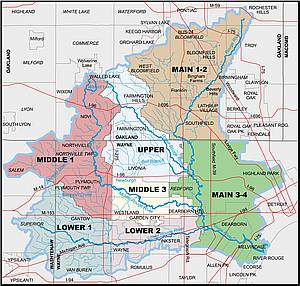
River Rouge Watershed


Planting shrubs and trees, creating water gardens and swales, installing cisterns, paving with water-permeable materials, disconnecting downspouts from drains and impeding construction site and agricultural soil erosion throughout the watershed will pay dividends downstream at retention basins, pumping stations and wastewater treatment plants, as well as in natural water bodies.  Lower costs in the system translate into lower sewer bills for everybody.

This would be a good time for a vigorous collaboration between the new Great Lakes Water Authority and the State of Michigan to expand watershed-wide stormwater controls like those described above.

Monday, December 29, 2014

Cost/Benefit Analysis of CSO Control Utilizing Green Infrastructure

The overflow of sewers that transport both stormwater and human waste is the bane of municipalities throughout the United States and elsewhere in the world. Traditional methods (so-called grey infrastructure) of controlling combined sewer overflows, such as huge containment tunnels, are extremely expensive.  


In recent years, municipalities, state agencies and the U.S. Environmental Protection Agency (EPA) have been studying and implementing green infrastructure (GI), sometimes referred to as low impact development (LID), as an alternative means of controlling sewer overflows.


An August 2013 study by EPA identifies instances of economic benefit derived from such alternative means, as well as methods of evaluating those benefits.


“The case studies were selected to represent a variety of analysis methods in different geographic areas of the United States, for different types of municipal programs. The case studies highlight locations where LID/GI applications, in combination with grey infrastructure, were found to be economically beneficial...”

“...Those entities that have begun to analyze their green infrastructure programs and practices
in order to ascertain the cost effectiveness of green infrastructure in comparison to 
grey infrastructure or hybrid systems have used different types of economic analyses, depending upon their objectives, resources, or other considerations.”


For example, the Philadelphia Water Department refers to its study “...as ‘triple-bottom-line’ (TBL) analysis, a term that has become recognized in municipal asset management to emphasize the financial-social-environmental aspects of a complete benefit-cost analysis, rather than only the financial.”

This is a long, comprehensive document.  With the appendix, it runs well over one hundred pages. Nevertheless, political leaders in southeast Michigan and appointees to the new Great Lakes Water Authority would be well advised to study it closely.

Thursday, December 11, 2014

MDEQ: No Rationale for Silt Runoff Disparity

In its FOIA response (sent December 9) below, the Michigan Department of Environmental Quality (MDEQ) seems to concede that it doesn't have a rationale for the double standard it maintains to control silt running off urban construction sites.  

Such runoff clogs sewers, adds to the burden of wastewater treatment plants and, during and after heavy rains, further pollutes combined sewer overflows (CSOs) that contaminate lakes and streams such as the Clinton, Rouge, Huron and Detroit rivers and lakes St. Clair and Erie.

As shown recently on this blog, the Oakland County Water Resources Commissioner (OCWRC) appears to have made the same concession.

The state permits qualifying municipalities to prohibit silt running from construction sites into city sewers.  These cities are referred to as municipal enforcement agencies (MEAs).  

Cities that don't qualify for such independent enforcement have construction site runoff managed by their county, which is referred to as the county enforcement agency (CEA).  State law would seem to limit county control of silt runoff to construction sites within 500 feet of natural water bodies or to sites larger than one acre, so building contractors under CEA supervision don't face a blanket prohibition to discharging silt into city sewers.

Either (1) the state legislature should correct this disparity in the statutes, (2) MDEQ should exercise its rule-making authority to require the higher MEA standard applicable to all construction sites, or (3) the courts should be asked to impose the same high standards across the board in furtherance of existing federal and state clean water laws.

*****  *****   *****


          Dear Mr. Lang: 
 SUBJECT:  Request for Disclosure of Official Files – Water Resources Division  
This notice is issued in response to your request for information under the Freedom of Information Act, 1976 PA 442, as amended (FOIA), received on November 13, 2014. You have requested the following information: “A rationale for the difference between the strict water quality and erosion control enforcement in MEAs and the lax enforcement by OCWRC in its role as CEA, as that rationale relates to Michigan waters and the public trust” (FOIA 0832-15).  
The purpose of the FOIA is to provide the public with access to existing, nonexempt public records of public bodies.  Your request to examine or receive a copy of the documents described above is denied.  
To the best of this public body’s knowledge, information, and belief, the public record does not exist under the name given by the requester, or by another name reasonably known to the public body.  
Under section 10 of the FOIA, the DEQ is obligated to inform you of the following:  
1)   Appeal this decision in writing to the Director of the Department of Environmental Quality, P.O. Box 30473, Lansing, Michigan 48909-7973.  The writing must specifically state the word "appeal," and must identify the reason or reasons you believe the denial should be reversed.  The head of the department, or his designee, must respond to your appeal within 10 days of its receipt.  Under unusual circumstances, the time for response to your appeal may be extended by 10 business days.  
2)   File an action in the appropriate court within 180 days after the date of the final determination to deny the request.  If you prevail in such an action, the court is to award reasonable attorney fees, costs, and disbursements, and possible damages.   
[signature omitted] FOIA Coordinator  
Department of Environmental Quality 
800-662-9278 
deqfoia@michigan.gov 
The DEQ strives to continually improve its customer service to FOIA requesters.  To provide input for improvements to the FOIA process, please complete this survey:https://www.surveymonkey.com/s/foiaprocess