Showing posts with label stormwater management. Show all posts

Thursday, September 10, 2015

Stormwater Summit; Contaminated Sites; Invasive Mussels

2015 Stormwater Summit

“Oakland County Water Resources Commissioner Jim Nash and his office, along with Pure Oakland Water and Lawrence Technological University, are hosting the third annual Regional Stormwater Summit on October 9, 2015.”

“Elected officials, government staff, industry leaders, engineers, environmentalists, and community members interested in sustainability, green infrastructure, keeping our waters clean, cutting edge projects and related environmental concerns are encouraged to attend.”

“Attendance is limited to the first 300 registrants. Cost to attend is only $20 and includes a light breakfast, box lunch, and beverages.”

Questions? Email or call Alyssa Atkinson:   atkinsonaa@oakgov.com or call 248-858-0967.  

Remediation of Contaminated Sites

There are significant changes to regulations for remediation of contaminated sites in Michigan. DEQ's Remediation and Redevelopment Division is presenting three Environmental Remediation and Risk Management Conferences.  Attendees will hear about how changes to Part 201 and Part 213 have created opportunities for cost effective remediation solutions.

The dates and places are October 1 in Novi, October 7 in Traverse City and October 14 in Grand Rapids.


The conferences will address the new Water Strategy and the importance of cleaning up contaminated sites for future generations.

DEQ's Remediation and Redevelopment staff will give updates on RCRA/Part 111 Corrective Action, Michigan’s Role in the TSCA PCB Remediation Program, Land and Resource Use Restrictions Overview, No Further Action and Redevelopment, Brownfields - Solving Technical Issues, and more.

Invasive Mussels


The Invasive Mussel Collaborative is offering a new listserv developed to promote communication among stakeholders engaged in zebra and quagga mussel management, control, research or related efforts. This new service began September 1.

“This listserv will be a forum for sharing information about invasive mussel control, research and management.  Appropriate postings include management strategies, field study results, permitting information, policy issues, research, etc. This list will also receive information from the Invasive Mussel Collaborative (http://www.invasivemusselcollaborative.net), including webinar announcements and other relevant information.”
 https://glc-lists.merit.edu/sympa/info/invasivemussels

Monday, August 24, 2015

Profitable Green Canopy and Stormwater

Let’s expand our green canopy in the upper regions of the Clinton, Rouge and Huron watersheds. Trees generate oxygen, capture carbon and absorb water. Tree roots also guide excess surface water down into the ground.

New York City, Philadelphia and Los Angeles already have plans to plant one million trees in 10 years, mostly with tax dollars, volunteers and philanthropy. What I have in mind for southeast Michigan is a different  model.

Overlooked by many green infrastructure advocates is that some trees have commercial value other than lumber.  We could increase the canopy and simultaneously create or expand commercial fruit orchards, Christmas tree farms, sugar maple groves, nut tree groves and ornamental tree nurseries, in addition to native woodland stands.
Image result for apple orchard

Chestnuts are grown as a cash crop in west Michigan.  Why not here in southeast Michigan?  In California, the meatier English walnut variety is grafted to native walnut rootstock.  Why not here?   

Growing trees for profit requires lots of water, a resource California and other southwestern states are running out of.  Michigan has a water advantage, and we should make the most of it.

If 120 communities in the Great Lakes Water Authority system each committed to planting 1,000 trees per year, we’d have a million more trees - and a magnificent canopy -  in less than 10 years. And if done as I suggest, the project would eventually pay for itself twice, first in stormwater control savings and second in cash crops.

Tuesday, July 7, 2015

Milwaukee Tackles Stormwater

I’ve written on this blog before, “The lesson over and over again is that big, downstream, end-of-the-pipe processes and facilities by themselves aren’t the solution to combined storm and wastewater overflows in large metropolitan areas.”


Susan Nusser reported in Urban Milwaukee on May 28, 2015 that the Milwaukee Metropolitan Sewerage District (MMSD) is implementing watershed based management and triple bottom line accounting.


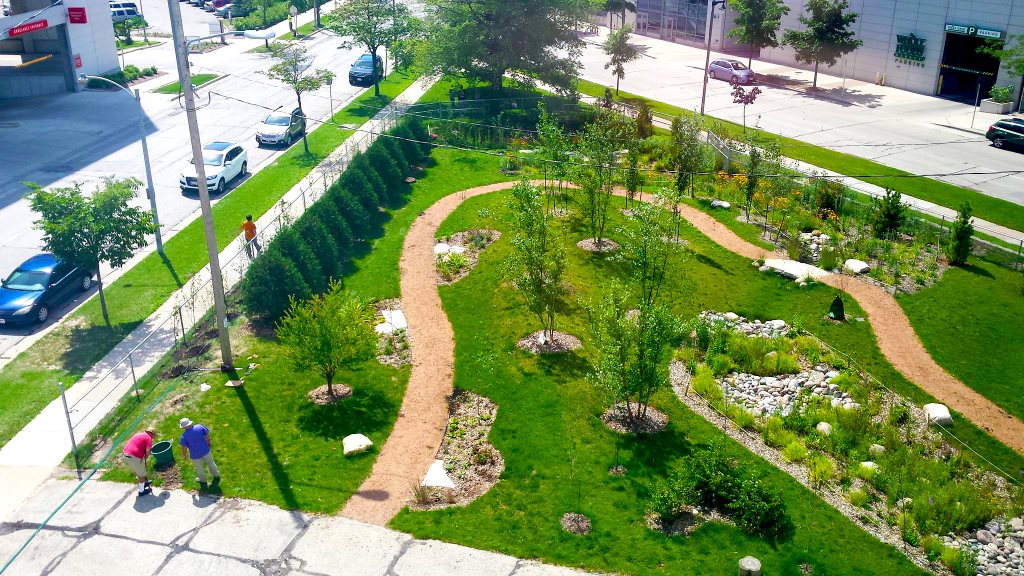
rain garden, Milwaukee.jpg


“Watershed-based management shifts the management of water resources from a gray infrastructure model: channeling water quickly and efficiently to a central location, treating it, and returning it to its source, to a green infrastructure model in which water is managed where it  lands.”


(Bear in mind that in Detroit, combined storm and wastewater surging through an inadequate gray infrastructure during major storms usually overwhelms the system, resulting in raw sewage or partially treated sewage being dumped into the region’s rivers and from there into Lake Erie.)


“...[A] new watershed permit enabled [upstream communities] to share costs on larger projects that would benefit the watershed, which means individual municipalities now get credit for work even though it’s not wholly within their political boundaries.”


MMSD’s decision years ago to practice triple bottom line accounting made collaboration on the new permit easier.  The new accounting system takes into account social, environmental and financial costs.


“Far better than building more expensive and high-maintenance tunnels and pipes was an approach allowing the water to be absorbed where it landed, and partnering with other entities and pooling resources for solutions.”


Nevertheless, “...MMSD’s goals far exceed those [Milwaukee] is on track to achieve. Currently the city is only capturing about 14 million gallons of storm water…”  The city’s goal is to increase green infrastructure by 10 percent annually.

Nusser quotes Milwaukee Commissioner of Public Works Ghassan Korban, “That’s how you start...You raise the bar. You set high expectations and you get everybody to collaborate and try to achieve the goal.”

Thursday, June 18, 2015

Stormwater Management: More Trees, Less Concrete


Chicago built a giant stormwater/wastewater retention tunnel as part of the city’s Tunnel and Reservoir Plan (TARP).  It’s similar to the tunnel system recommended years ago for Detroit (which Detroit couldn’t afford).

But following storms earlier this week, Chicago’s Deep Tunnel filled to capacity and overflowed, spilling polluted stormwater into Lake Michigan.  CBS in Chicago (WBBN) reported, “ ‘All the tunnels combined, it’s 2.3 billion gallons of capacity that we maxed out,’ MWRD supervising civil engineer Ed Staudacher said.”

The lesson over and over again is that big, downstream, end-of-the-pipe processes and facilities by themselves aren’t the solution to combined storm and wastewater overflows in large metropolitan areas.

Another lesson is that concrete and steel remedies such as the retention-treatment basins (RTBs) that are being expanded in Detroit’s system cost more but aren’t as effective as well planned, region wide green infrastructure.

In New York City, Philadelphia and Los Angeles, for example, forward thinking leaders designed and are completing projects to plant a million trees each.

Trees generate oxygen, remove pollution, store carbon, save energy, improve water quality and slow stormwater runoff.

If each of the 120 upstream communities in the Great Lakes Water Authority (GLWA) system rallied service clubs, chambers of commerce, church groups and Boy Scout and Girl Scout troops to plant with thoughtful placement 1,000 trees per community per year, we’d have a million new trees in eight or nine years.  It’s doable.